Jos, a city in ruins, a people in pains
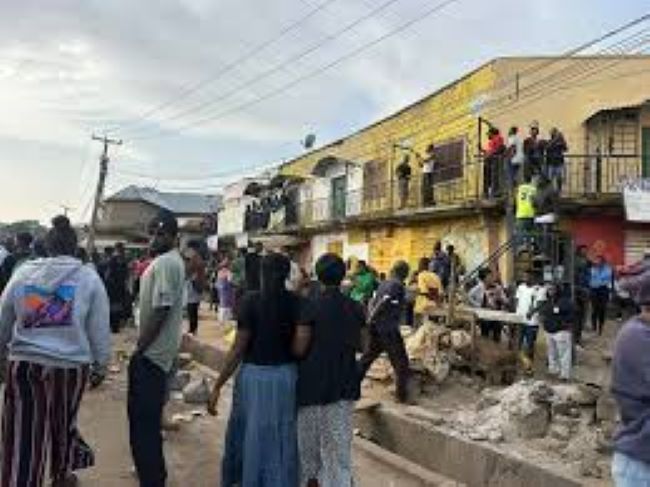
A violent attack in Angwan Rukuba, Plateau State, on Palm Sunday | Photo: Facebook
By Emeka Alex Duru
(08054103327, nwaukpala@yahoo.com)
It should not have required extra intelligence for anyone following the trends in Jos, the Plateau State capital, to decode the tension in the city.
A three-day visit to the state in September last year, was all that it took for me to conclude that Jos, the Tin City that one knew, had lost its placidity and had in fact, become a timebomb waiting to explode.
By what seemed a conspiracy of coincidences, everything I knew about Jos, had changed.
The usual alluring climate normally associated with September, had given way to excruciating heat.
The characteristic smiling faces of residents, even in poverty and the kindred spirit in the midst of multiple cultures and languages, had evaporated. In their stead were hostile faces, pent-up anger and barely concealed animosity at no one in particular but against everyone.
A tour around the major roads in the city, confirmed the suspicion that all was not well.
In some areas, rubbles of buildings torched at previous disturbances, offered disturbing spectacles.
Inside commercial buses that ordinarily provided forums for social exchanges, the mistrust was large.
There were no banters, no common issues of discussion.
Everyone kept to himself. The message was not lost on me – Jos, the city I knew and was proud of was in ruins, and the people in pains!
Only one that had lived in Jos in its days of innocence and harmony would appreciate the extent of rape the city has undergone in the hands of bloodthirsty hounds with the government not rendering any tangible help.
I had once told the story of my encounter with Jos on this space.
I was in the city for a graduate programme in University of Jos (UNIJOS) in the early 1990s.
Before then, I had longed to visit Plateau. Growing up, my parents, especially my mother, regaled us with stories of the beauty and serenity of Jos.
My family was in Jos during our infancy before it was forced out of the city following the crisis and pogroms of 1966 that eventually snowballed to the civil war.
Those tales fired my imagination and the urge to visit Plateau.
While in UNIJOS between 1991 and 1993, I confirmed the beauty and placidity of the place. The unique Jos weather, relative low cost of living, peaceful environment and fellow-feeling among the residents, compared to no other place in the country.
It was in Jos, that for the first time, I saw churches and mosques sharing the same compounds or separated by thin walls.
Angwan Rogo where I lived with other students, was behind the University and predominantly populated by Muslims.
But it did not really matter to us. At festive periods by either Christians or Muslims, we were served with food items by wealthy members of the faith celebrating.
Nobody in the neighbourhood, to my knowledge, was discriminated against or attacked on the basis of faith, sect or ethnicity.
It was not for nothing that we prided UNIJOS as a mini-Nigeria; an institution that had many students living in peace without any group dominating the others.
Sadly, that era is gone.
The Tin City has lost its ambience and beauty. Violence and intolerance have taken over.
It was so bad that in September last year when I had cause to be in Jos, I learned with pains of the existence of metaphorical “Wall of Jericho” by which the residents were divided on religious lines.
Even without official pronouncement, some parts of the city were inhabited by Muslims, while Christians had their zones of habitation.
It rankled in particular that a friend that I pleaded with to take me to my former place of residence in Angwa Rogo, bluntly refused to go and advised me against embarking on the trip, which he said was risky.
That spoke much on how bad things had gone.
This is the depressing story of Jos and entire Plateau; an unflattering index of state failure and irresponsibility on the parts of successive leadership in the state and country.
The March 29, Palm Sunday terrorist attack on the capital city in which over 30 residents were killed, was therefore not surprising. It was rather a manifestation of the disharmony in the city, a spillover of unmanaged tension and mismanagement of the already parlous security situation in the state. Put in other words, it was an accident waiting to happen.
The laxity in preventing and managing the situation showed in the tepid attitude of the leadership of the state and lifelessness of the federal government, while the City boiled.
Neither the governor, Caleb Mutfwang, nor the President, Bola Tinubu, promptly rose to the occasion to give the people the needed assurance of protection.
It took efforts for the governor to dismount from an armored car to address the people directly.
For Tinubu, a visit to the City, merely ended at Yakubu Gowon (Heipang) Airport.
This is in line with the serial lapses and failures that have feathered the recurring crisis in Jos.
It is one in which after the initial assurances of getting to the roots of the problem, nothing is done.
The fraud did not commence with the latest Palm Sunday mayhem and may not end with it.
For over 30 years, Jos has experienced repeated crises which have eroded the peace and tranquility which the city was known for.
Within the period, the Federal and the Plateau State government have established six Commissions of Inquiry into the various crises.
These included the Justice J. Aribiton Fiberesima Commission of 1994, set up by the then Military Administrator of the State, Lt. Col. Mohammed Maina, to investigate the riots that erupted in the metropolis on April 12, 1994, over the appointment of a Hausa-Fulani person as the chairman of Jos North Local Government Area, which was contested by the indigenous Berom, Anaguta, and Jarawa ethnic groups.
A deadly outbreak of violence in the city on September 7, 2001, which resulted to loss of hundreds of souls, massive destruction of properties and worship centres, led to the setting up of the Justice Niki Tobi Commission, by Governor Joshua Dariye.
Another crisis in 2009, saw the establishment of Justice Bola Ajibola (SAN) Commission of 2009 by Governor Jonah Jang.
Ajibola panel faulted the creation of Jos North Local Government Area, LGA, by former Military President, Gen. Ibrahim Babangida, retd.
It recommended that the present Jos North LGA be re-delineated into three sustainable local governments with an equitable representative number of wards within each local government.
Unfortunately, in all the efforts, the reports were never published, never fully debated, and never translated into action.
It was a case of motion without movement. More than any other lapse, the non-implementation of the findings of the Commissions, seems to widen the scope of impunity and encourage more attacks on innocent citizens in Jos.
Tinubu’s lame-duck visit to Heipang Airport and the rootless threat of dealing with the masterminds of the attacks, cannot do much in stemming the tide of violence in the city. Neither, will the timorous approach by Governor Mutfwang in defecting to the President’s All Progressives Congress (APC) do much in keeping the murderous marauders at bay.
Rescuing Jos from its continuous ruins, easing the pains inflicted on the people, go beyond the tokenistic overtures by President Tinubu and Governor Mutfwang.
It requires strategic thinking, mustering the political will to get to the root of the recurrent violence and taking decisive actions against the agents of the bloodbath and their sponsors.
Until such measures are taken, Jos and other cities in Plateau, will continue to bleed, while the leaders keep throwing their hands in the air in utter helplessness.
.Emeka Alex Duru, PhD, is the Editor, TheNiche Newspapers, Lagos
….………
For more interesting stories, click: nigerianewsflight.com.ng
valoa2000@yahoo.com
Soldiers Buy Uniforms with Low Salary, Says Dismissed Office
Dismissed Nigerian soldier, Rotimi Olamilekan, popularly known as Soja Boi…Photo Credit: Sahara Reporters
A dismissed Nigerian soldier, Rotimi Olamilekan, popularly known as Soja Boi (with the service number 18NA/77/1009 LCPL), serving with the 81 Division Task Force Battalion in Borno State, has alleged that personnel of the Nigerian Army purchase their uniforms and protective gear with personal funds despite earning modest salaries.
The former lance corporal, Olamilekan, a military content creator known for his humorous videos, made the claims in a yet-to-be-released interview on the Honest Brunch Podcast alongside human rights activist Omoyele Sowore.
Speaking during the interview, he disclosed details of his earnings while in service, noting that his salary was recently increased.
“As a soldier, like presently now (Before he was dismissed in March), them dey pay me, the last salary wey I collect for army N109,000 or N111,000. But before that, it was just last year, February, that they increase the salary. Before now, N51,000,” he said.
He added that allowances brought the total to about N70,000 before the increment, but described survival on such income as extremely difficult.
“And how were you surviving on 71,000 Naira? The suffer, suffer no be small. Apart from the salary, nothing more. Nothing dey enter for you as a soldier,” he said.
Olamilekan further alleged that soldiers are responsible for purchasing their own uniforms, which he said are costly.
When Sowore asked, “What about uniform? Did they give you uniform?, Soja Boi replied, “No, they don’t give uniform now, soldier. Ask any soldier. They buy them,” he said.
Providing cost estimates, he noted that uniforms and boots often exceed a soldier’s monthly salary.
“The uniform is about N55,000. Yes. Now you go buy uniform, now you go buy boots, now you go buy anything you want to use. The boots, sometimes N60,000 for one pair of boots,” he said.
The dismissed Nigerian soldier, Rotimi Olamilekan, popularly known as Soja Boi…Credit: Instagram/ Soja Boi
He also claimed that essential protective gear, such as bulletproof vests and helmets, is not provided, except in rare situations.
Sowore also asked,”What about armour bullet proof, helmet… all those ones, they don’t give you. So you buy it yourself?”
He replied,” I swear, nobody will give you. ” he said.
According to him, such equipment is only made available during special visits by high-ranking officials.
….……..
For more interesting stories, click: nigerianewsflight.com.ng
valoa2000@yahoo.com
….……..
For more interesting stories, click: nigerianewsflight.com.ng
valoa2000@yahoo.com