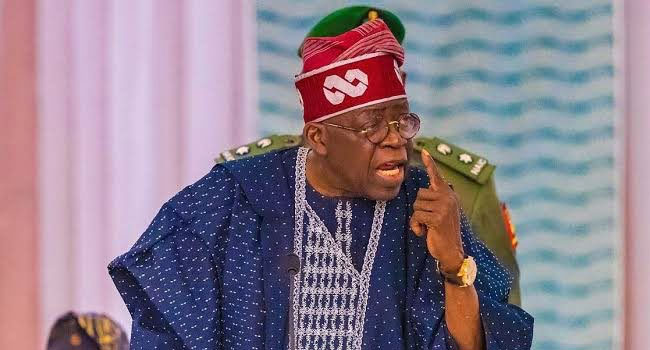
President Bola Tinubu of Nigeria | File Image
By Ndubuisi Chikezie
Loyalty can be as commonplace as it is ambiguous.
Its origin and meaning seems to have added to the seeming implacability.
The Encyclopædia Britannica, Eleventh edition defines loyalty as “allegiance to the sovereign or established government of one’s country.
These days, it can be countries, a topic for another day. Loyalty may be defined as an individual expressing a strong commitment and dedication to another person, or group, nation or ideal.
The phenomenon has evolved, but it has refused to loose its significance in the process.
The word is derived from the old French word loialte (modern loyauté), which ultimately stems from the Latin root lex, meaning “law”.
Another school of thought attributes the origin to Latin roots: The word loyalty has its origin in the Medieval Latin word legalitas, or leaute (mid-13th century).
Historically, loyalty has been credited to renowned Chinese scholar and teacher, Confucius (551- 479 BC), who taught the concept of filial piety, the basic ethical attachment, as an expression of loyalty to one’s parents family, elders in the society and ancestors.
In his opinion, ‘the scholar does not consider gold and jade to be precious treasures, but loyalty and good faith’.
From the perspective of sentiment and devotion: loyalty goes beyond mere obedience; true loyalty involves a deep emotional attachment and an ever ready sentiment supporting a cause or person.
Generally, loyalty manifests across many facets of human life, including personal relationships, national patriotism (allegiance to a state), and consumer habits (brand loyalty).
Loyalty is always deaf, dumb and blind to trending happenstances, even when they may have substance.
In his own renowned view, Plato (428-347 BC), well known Greek philosopher and scholar in his book, “Republic” argued that governing officials may show greater loyalty to their families than the state, resulting to conflict of interest.
Again, one of Plato’s outstanding students, Aristotle (384-322 BC), held the idea that one should be loyal to the city-state above all else, and through that loyalty, people could realize their aspiration and highest goal.
In this vein, loyalty may be jaundiced with the concept of political proximity, which explains the connection between individuals, or organizations and political office holders.
Is he from my place?. Let him be there although there may not any chance of a direct benefit; but some form of extended prebendalism.
“Civis Romanus Sum”, meaning, “I am a Roman citizen” is believed to be akin to the zenith of loyalty and patriotism – a supreme virtue, which could see one dying for his country.
Can we say “civis Nija sum”, with this outstanding trait, often regarded as a virtue in the class of wisdom, honesty, compassion, justice, courage etc. Loyalty improves the strength of friendship and relationships, the concept can be ambiguous, as we observed earlier; in situations like abuse of power (abuse or corruption of patriotism), bullying and violent, ‘do-or-die’ behaviour, loyalty may not be warranted; rebellion may be in the interest of the survival of the state.
However, loyalty when supported by mutual respect, appreciation, truth, trust, morality and faithfulness, becomes an excellent virtue to behold.
Loyalty to a dictator, tyrant or abuser may lead to disastrous outcome, and its virtue permanently impaired.
Loyalty, can assume another garb where the concept is naturally expanded to include personal devotion to feudal lords, sovereigns, and principles.
Unbridled loyalty is a recipe for institutional corruption, stagnation and disenchantment; revolt and civil disobedience, the very antonym of loyalty.
Merit, unlike loyalty fundamentally refers to the quality of being particularly good, worthy, or deserving of praise, reward, or attention. When used as a noun, it represents earned excellence: and a verb, it denotes that someone or something has earned or deserved a particular consideration, a praiseworthy quality.
It weighs heavier than loyalty given Aristotle’s maxim of justice; when he opined that justice means giving every individual what he or she deserves, meaning that justice demands balance, which in turn demands objectivity divorced from emotions.
Merit is always a ready metric when competitiveness which underlines efficiency is of utmost importance.
For instance, hiring decisions are based on merit; as the saying goes, “pay peanuts, hire monkeys” admissions officers judge one’s merit by looking at the past accomplishments and antecedents.
But merit is not just about one’s past: it is about one’s future potential.
Competitors are judged on their own merits: reward or punishment, credit held to be earned by performance of righteous acts and to ensure future benefits.
Merits in plural suggest the substance of a legal case apart from matters of jurisdiction, procedure, or technicalities.
Uncontrolled emphasis on merit risks estrangement, and disconnection from people.
Merit can be abused when there is scarcely anything “excellent about some of our Excellencies”
Democracy is an irony of some sort!
Ordinarily, the term is populist, a system that births a classless society.
On its face value, an utopian state; leaving everyone something to cheer about.
But if a system guarantees the survival of majority – however this is determined – leaving the balance with short end of the stick, the scenario is therefore far from uhuru.
Yet it is said that democracy empowers the collective—each essential, yet each imperfect on its own.
Democracy has its highs and lows: modern societies are condemned to its practice, but its variant seems to be dictated by systems such as political culture, level of development, tradition, and values.
In some climes the common denominator may be “ ubuntu” and for others, it may “all is fair in politics”.
Perhaps, the social contract theory never envisaged too much democracy which may slow decisions, virtually leaving no one in charge; but political systems must rely on merit, citizen loyalty to democratic values—rule of law, constitution, national identity.
.Dr Ndubuisi Chikezie is an Economist.
….……
For more interesting stories, click: nigerianewsflight.com.ng
valoa2000@yahoo.com